{ "@context": "https://schema.org", "@type": "Product", "name": "IoT Water Quality & Level Monitoring System", "description": "Real-time IoT water monitoring for dams, reservoirs, and bulk water infrastructure. Level tracking, quality assessment, leak detection, and consumption analytics.", "provider": { "@type": "Organization", "name": "Inovosystems" }, "category": "IoT Systems" }
Real-time monitoring for dams, reservoirs, and bulk water infrastructure. Level tracking, water quality assessment, leak detection, and consumption analytics — all over a hybrid IoT network.
Manual water monitoring is expensive, error-prone, and dangerous. Field operators physically visit each site, take readings by hand, and report back — by which time the data is already hours or days old. Water losses through leaks, evaporation, and infrastructure failure can account for up to 40% of total supply in arid regions, and manual methods cannot detect them in time.
Leaks, contamination events, and sudden level drops are only discovered at the next manual inspection — hours or days later. By then, thousands of litres may already be lost.
Manual readings are inconsistent. Operators work in remote, often hazardous conditions. Data entry errors compound over time, making trend analysis unreliable.
Without continuous monitoring, operations teams have no early warning system. A burst pipe, failed pump, or contamination event goes unnoticed until it becomes a crisis.
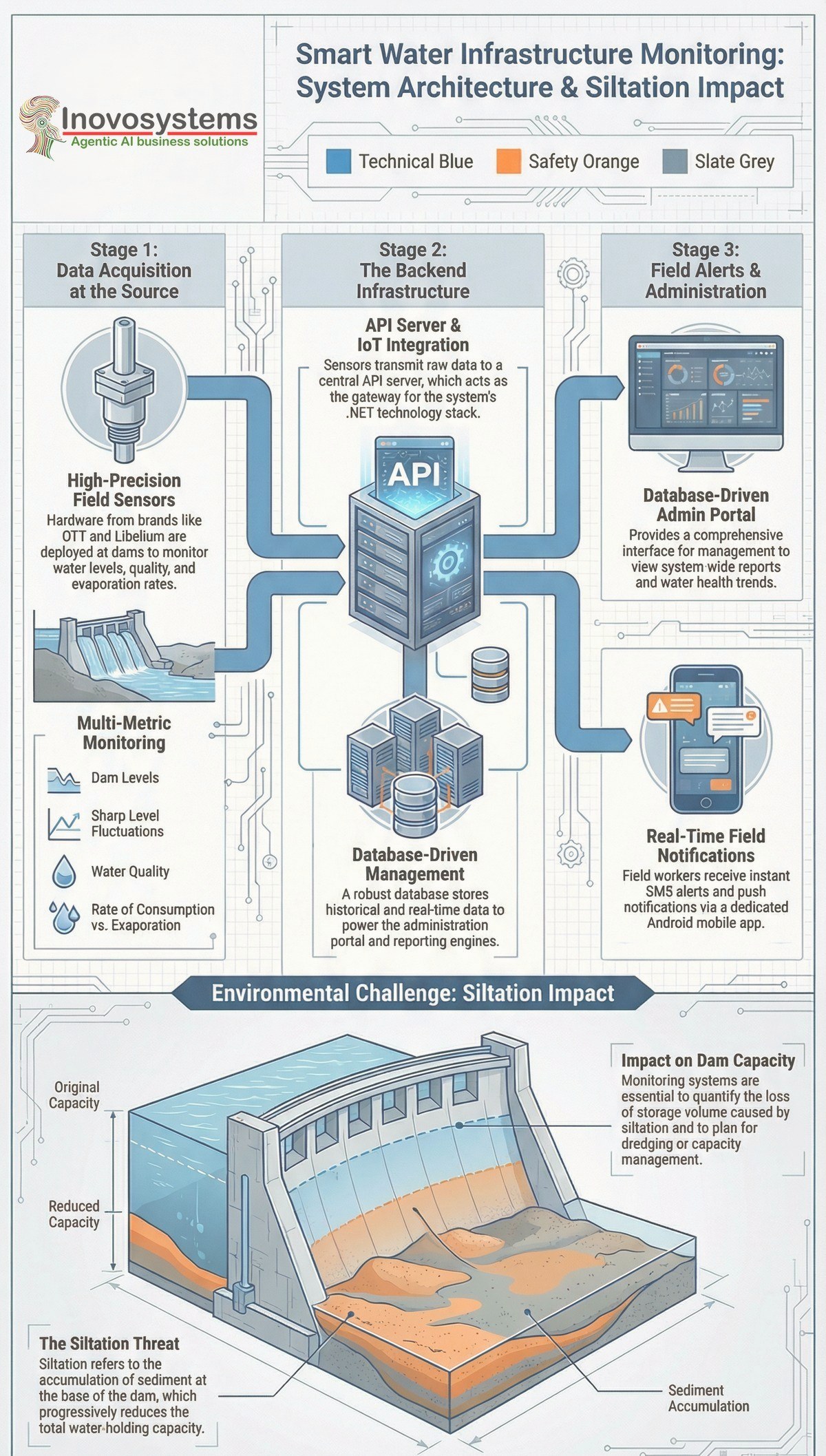
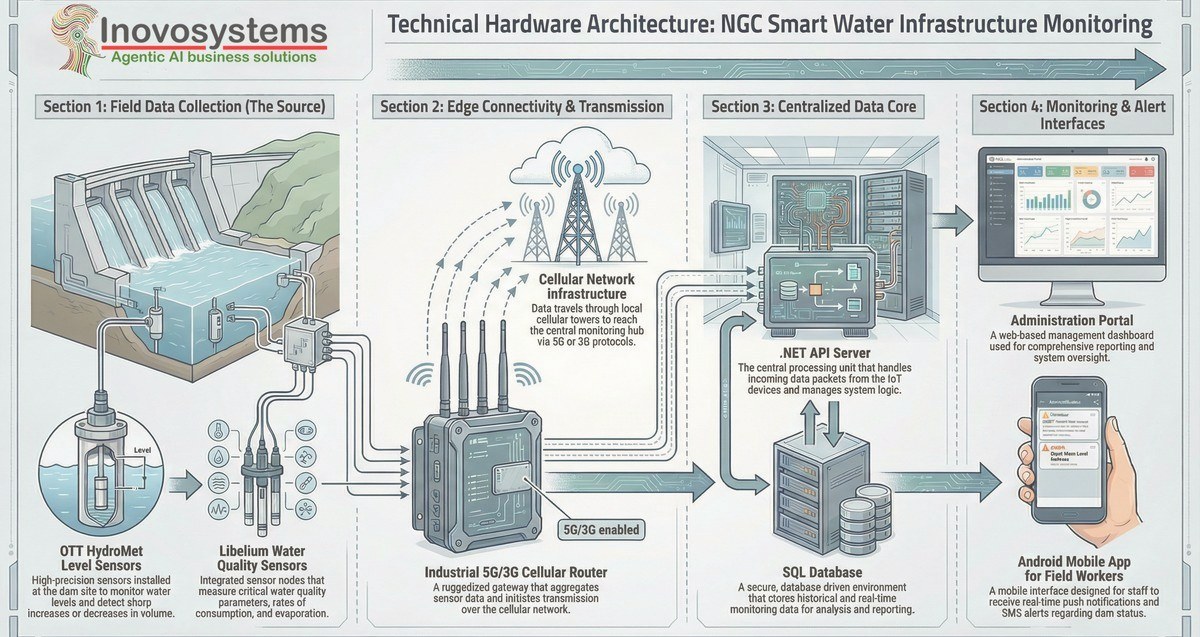
An end-to-end IoT Smart Water Management System built on a three-tier architecture: precision sensors at each site, a hybrid communication network, and a centralised command centre with a web portal and mobile app.
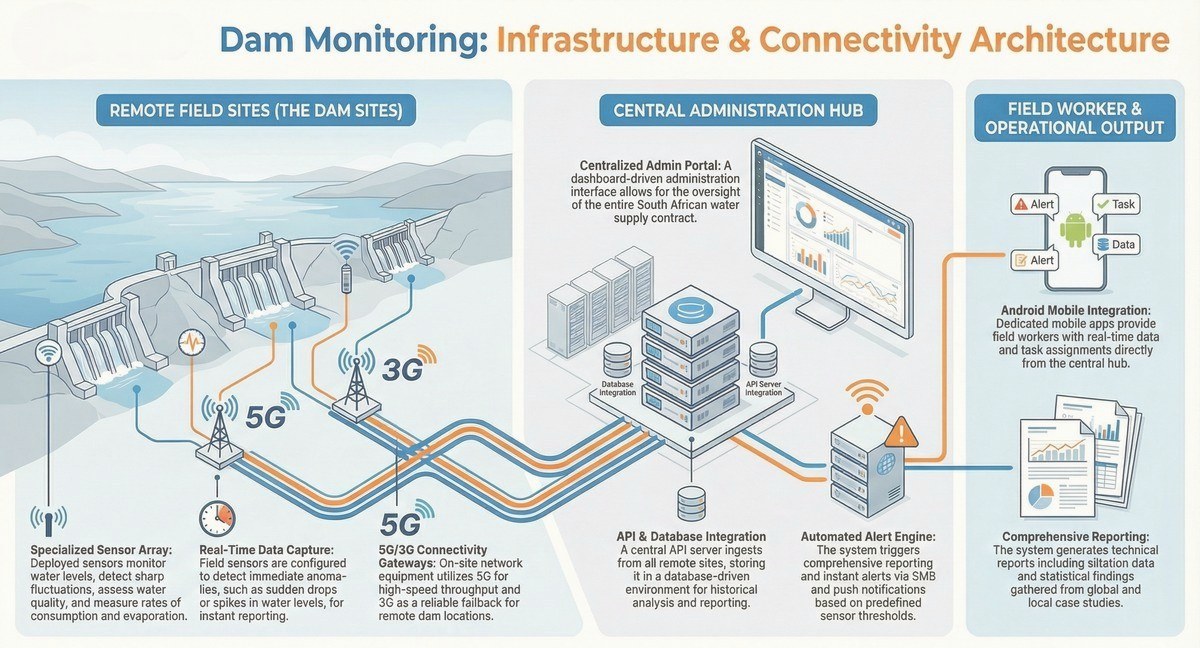
Complete system overview — sensors, communication, cloud platform, and user interfaces.
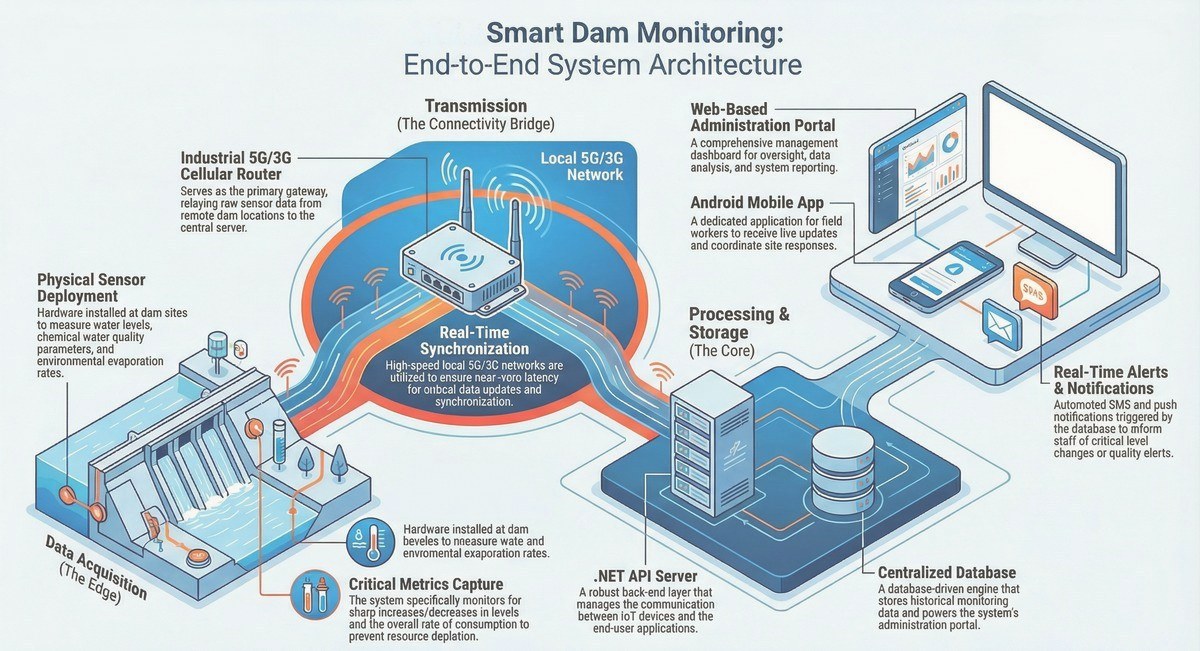
End-to-end system architecture — sensors, gateways, servers, and user interfaces.
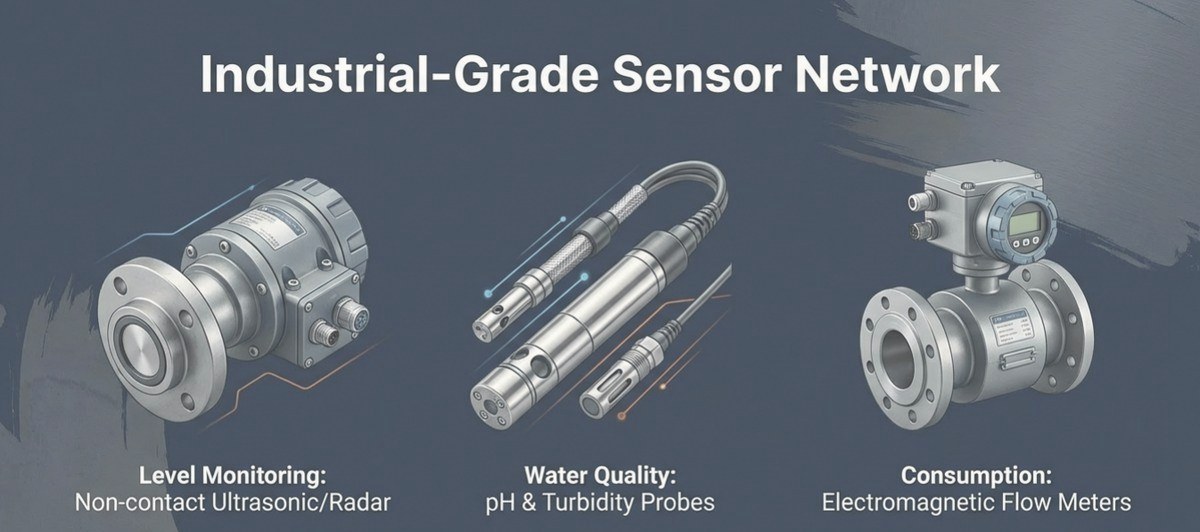
Industrial-grade sensor arrays for level, flow, and water quality measurement. Edge logic handles local data processing — readings are validated and serialised before transmission, reducing network load and improving reliability.
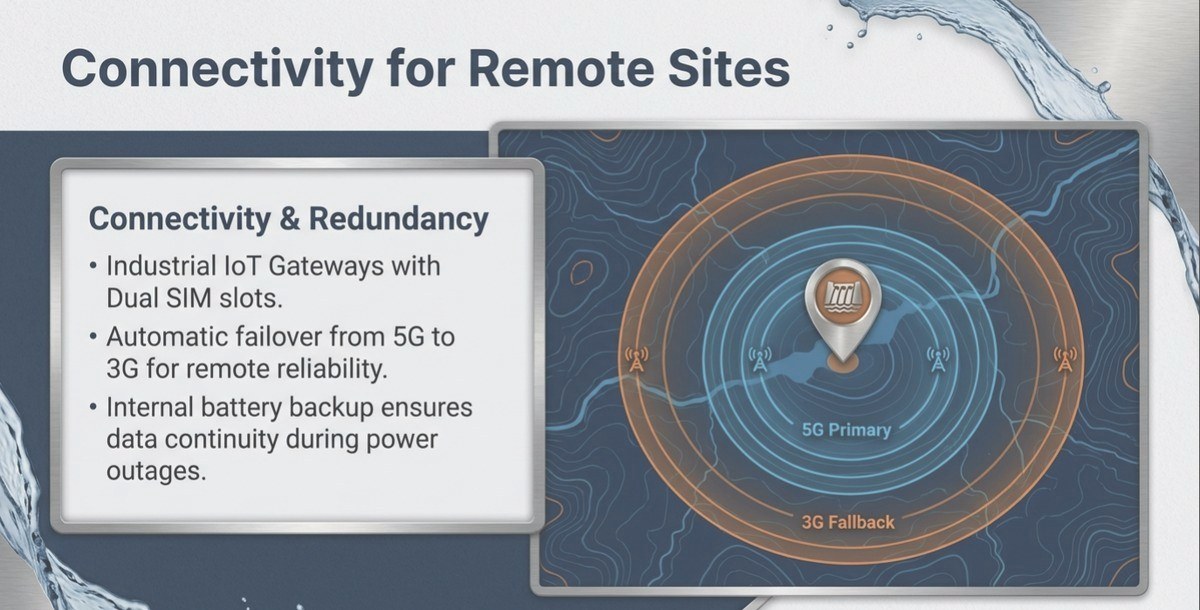
A hybrid communication fabric using LoRaWAN for remote dam sites, NB-IoT or 4G for urbanised infrastructure, and satellite backhaul for the most isolated locations. Designed for 99.999% data delivery.
A centralised command centre with a database-driven admin portal and a ruggedised Android mobile app for field engineers. Intelligent alerting, anomaly detection, reporting, and SCADA integration.
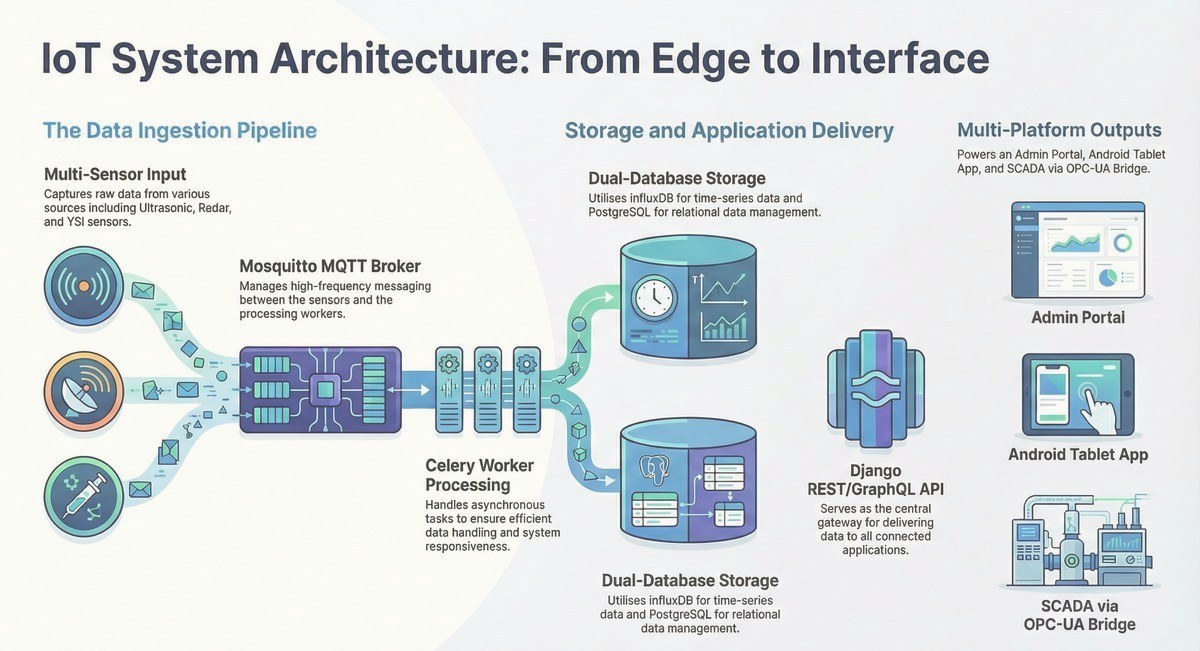
Three-tier architecture overview — edge, network, and application layers.
Precision tracking of reservoir volumes using industrial-grade radar and pressure sensors. Accuracy within ±2mm, with real-time alerts for sharp fluctuations indicating leaks, structural issues, or unauthorised abstraction.
Continuous monitoring of pH, turbidity, dissolved oxygen, conductivity, temperature, and chemical contaminants. Instant alerts when parameters fall outside regulatory limits — before water reaches consumers.
Real-time analytics detect abnormal patterns — sudden pressure drops, unexpected level changes, or unusual flow rates. The system triggers immediate notifications, cutting response time from days to minutes.
Scientific modelling of water usage versus environmental loss. Separates consumption from evaporation to provide accurate water balance reports, supporting better resource planning and loss reduction strategies.
A database-driven web dashboard for operations teams and an Android mobile app for field workers. Real-time data, historical trends, map views, and alert management from any device.
Seamless integration with existing SCADA systems via OPC UA and industry-standard protocols. The IoT system augments your existing infrastructure — it doesn't replace it.
Every site is different. We design a connectivity solution that matches the location — urban, rural, or completely off-grid.
Hybrid connectivity — LoRaWAN, NB-IoT, 4G, and satellite backhaul.
Industrial-grade hardware designed for outdoor deployment.
We build with proven, maintainable technology — not experimental frameworks. Three stack options depending on your team's expertise and performance requirements.
Technology stack options covering the full system — sensors to dashboards.
Recommended for most deployments. C#/.NET API backend with SQL Server or PostgreSQL, Azure IoT Hub integration, Blazor Admin Portal, and Xamarin/MAUI Android app. Mature ecosystem, strong typing, excellent tooling.
Best for high-concurrency, event-driven architectures. Express or NestJS API, MongoDB or TimescaleDB, React dashboard, React Native mobile app. Ideal when your team has strong JavaScript expertise.
Best for data-science-heavy deployments. Django REST Framework, PostgreSQL with TimescaleDB for time-series data, React or Django Templates dashboard. Excellent for advanced analytics, ML-based anomaly detection, and reporting.
Sensor specifications and hardware components for water monitoring.
This product integrates with our broader IoT and AI service offerings.
AI-powered anomaly detection, predictive maintenance, and automated alerting for IoT infrastructure.
Full-stack IoT development — from sensor integration and edge computing to cloud platforms and mobile apps.
Scalable API design, time-series databases, and real-time data pipelines for mission-critical IoT systems.
We design and deploy IoT water monitoring systems for dams, reservoirs, and bulk water infrastructure. Tell us about your sites and we'll propose the right architecture.
Let's Talk →